Showing posts with label PNEUMATICS. Show all posts

Tuesday, February 15, 2011

How does a 5/2 way directional valve work?


This instrument is not new to me. Since We started our pneumatics class on my third year in college, I already had the pleasure to meet this instrument. We even had to use this almost everyday, during our laboratory exercises. Its always present in all our 
pneumatic and hydraulic trainers. How does this stuff really work? 


A valve is a device that regulates the flow of fluid (gases, liquids,fluidized solids, or slurries) by opening and closing or partially obstructing passage ways 1.

A 5/2 way directional valve from the name itself has 5 ports equally spaced and 2 flow positions. It can be use to isolate and simultaneously bypass a passage way for the fluid which for example should retract or extend a double acting cylinderThere are variety of ways to have this valve actuated. A solenoid valve is commonly used, a lever can be manually twist or pinch to actuate the valve, an internal or external hydraulic or pneumatic pilot to move the shaft inside, sometimes with a spring return on the other end so it will go back to its original position when pressure is gone, or a combination of any of the mention above.
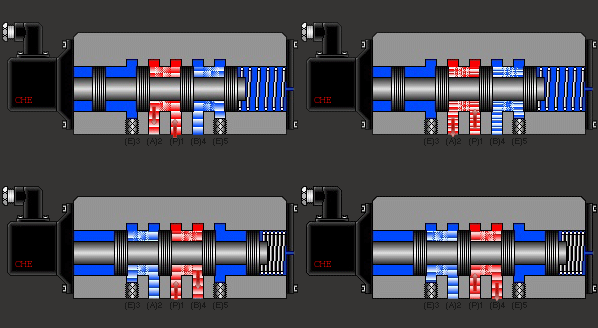


In the Illustration given, a single solenoid is used  and a spring return is installed in the other end. The inlet pressure is connected to (P)1. (A)2 could possibly be connected to one end of the double acting cylinder where the piston will retract while (B)4 is connected to the other end that will make the piston extend. The normal position when the solenoid is de-energized is that the piston rod is blocking (B)4 and pressure coming from (P)1 passes through (A)2 that will make the cylinder normally retracted. When the solenoid is energized, the rod blocks (A)2 and pressure from (P)1 passes through (B)4 and will extend the cylinder.and when the solenoid is de-energized, the rod bounces back to its original position because of the spring return. (E)3 and (E)5 is condemed or used as exhaust.

See how cool the combination of Electronics and Pneumatics is? There will be alot more illustrations on pneumatics and hydraulics instruments coming soon that you should'nt missed. I hope you enjoy reading. 


Friday, February 11, 2011

Instrumentation In Process Control

Instrumentation is defined as the art of science in measurement and control 1

Instruments can be found anywhere, they can be found in laboratories, refineries, factories, vehicles and even at school and in our homes too. For example, the faucet which Sarah quoted as the saddest instrument controls the flow of water flowing to the kitchen sink or a glass. In western homes  smoke detector is also a common instrument.

In the plant industries, Instrumentation is the art of measuring the value of some plant parameter, pressure, flow, level or temperature and supplying a signal that is proportional to the measured parameter. The output signal can then be processed by another instrument or equipment to provide indication, alarms or automatic control. There are a number of standard signals; however those common are the 1-5V and 4-20 mA electrical and electronic signal the 3-15 psi or 20-100 kPa pneumatic signal. I remember Engr. SalvaƱa always reminds us to remember this standards when we go and apply for a job. It helped though. Thanks to our hydraulics class instructor.

Output instrumentation includes devices such as solenoids, valves, regulators, circuit breakers, and relays. These devices control a desired output variable, and provide either remote or automated control capabilities. These are often referred to as final control elements when controlled remotely or by a control system.

Transmitters are devices which produce an output signal, often in the form of a 4–20 mA electrical current signal, although many other options using voltage, frequency, pressure, or ethernet are possible. This signal can be used for informational purposes, or it can be sent to a PLC, DCS, SCADA system, or other type of computerized controller, where it can be interpreted into readable values and used to control other devices and processes in the system.

Control Instrumentation plays a significant role in both gathering information from the field and changing the field parameters, and as such are a key part of control loops.